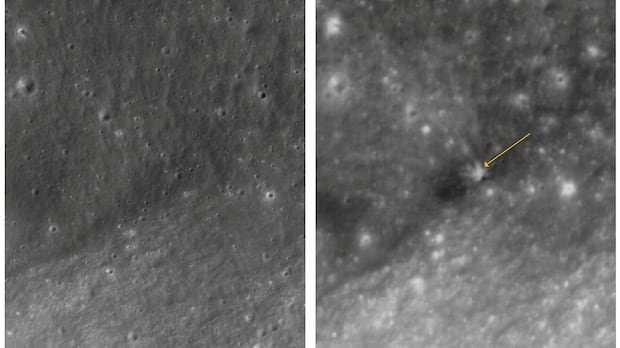
The newly released photos show a bright, elongated scar on the Moon’s surface, contrasting with the pre-crash lunar terrain. Scientists noted that the alteration appears to be a discernible disturbance in the regolith, the top layer of loose lunar soil, consistent with a high-velocity impact. The imagery provides researchers with a direct record of the event and its aftermath, offering potential data for analyzing cratering mechanics and the distribution of ejecta around the impact area.
Officials described the phenomenon as a definitive impact mark rather than a surface anomaly, emphasizing that the Moon’s lack of atmosphere allows such features to remain for extended periods. The satellite’s analysis aims to determine the scale of the crash, including crater dimensions and the extent of material displacement, by comparing the post-crash photographs with earlier baselines of the same lunar region.
SpaceX has not issued a formal comment on the crash’s scientific implications or the exact location of the impact site. The event is part of ongoing discussions about debris and safety considerations for spaceflight activities, particularly missions involving spent rocket stages and other hardware that could pose collision risks with celestial bodies during uncontrolled reentries.
Experts caution that while lunar missions add to our understanding of space technology and its environmental footprint, any conclusions about the broader impact on lunar geology will require further corroboration from multiple datasets and high-resolution imaging over time. The current observations, however, provide a concrete record of the moment and the immediate aftermath of the SpaceX collision on the Moon.