The “Secret Sauce” Isn’t a Secret
We are often obsessed with the idea of financial alchemy—the search for that “one weird trick” or the lightning strike of a lucky windfall that will transform our bank accounts overnight. But as we navigate the economic landscape of 2026, it becomes increasingly clear that wealth is rarely the result of a single, explosive event. Instead, it is a byproduct of a series of rather mundane behaviors stacked on top of one another.
Wealth isn’t fundamentally about how much you make; it’s about how you think and what you choose to do on a random Tuesday when no one is watching. If we peel back the curtain on the “secret sauce” of the affluent, we find it’s composed of ten habits that move the needle not through magic, but through the relentless physics of consistency.
The “Inner Circle”: The 10 Habits for Financial Freedom
To understand how modern wealth is built, we must look at the “Inner Circle” of behaviors that successful individuals have turned into their default settings.
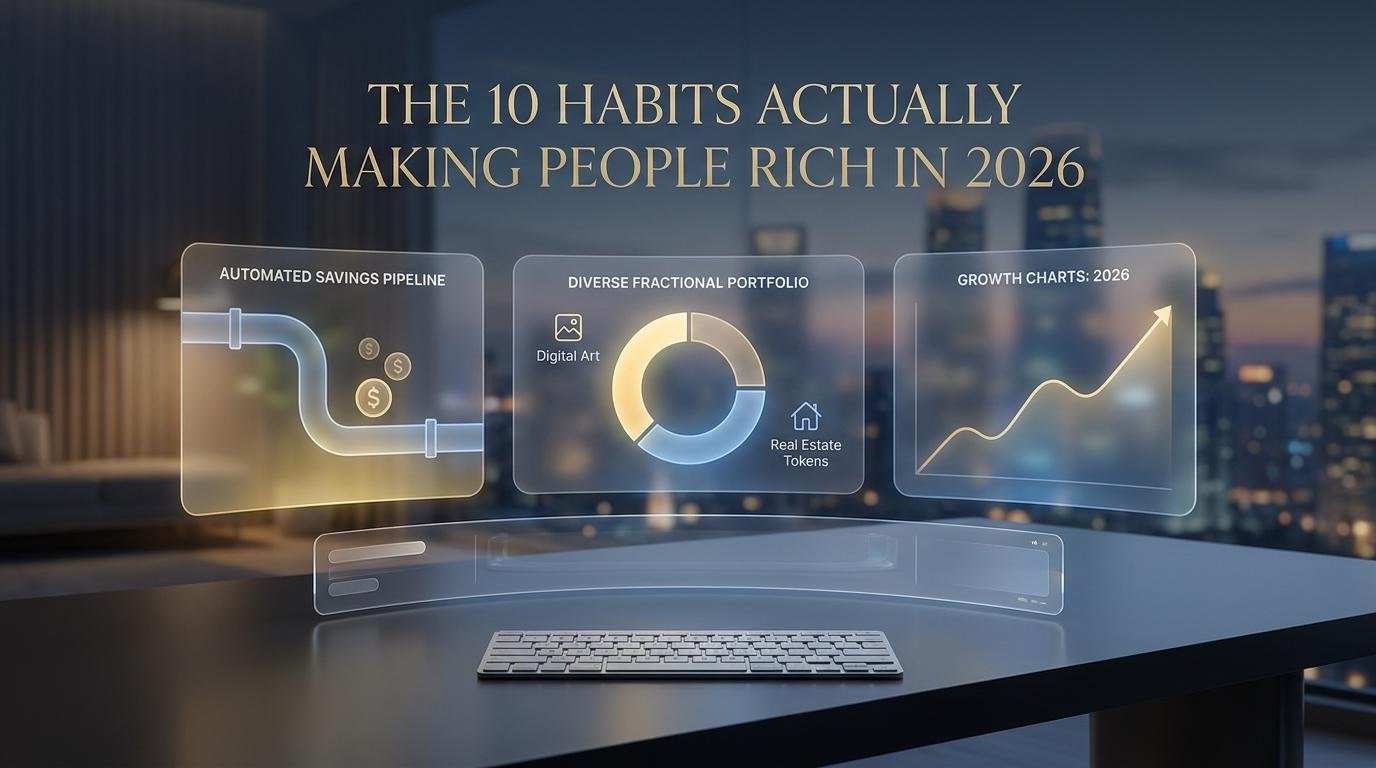
- The Auto-Pilot (Automation): We have finite willpower. The wealthy solve this by “paying themselves first” through automated systems. By the time their paycheck hits their spending account, the money for investments has already vanished into brokerage accounts. If you don’t see it, you can’t spend it on an overpriced espresso.
- The Anti-Flex (Living Below Your Means):There is a profound difference between looking rich and being wealthy. We see this in Warren Buffett, who famously still resides in the Omaha home he purchased in 1958. It is the habit of avoiding “lifestyle creep” even as your income scales.
- Nerd Power (Continuous Learning):Research suggests that 88% of wealthy individuals spend at least 30 minutes a day reading for self-improvement. In 2026, where AI is shifting the job market every six months, “learning how to learn” is the ultimate competitive advantage.
- The “Slow and Steady” (Dollar-Cost Averaging): This is the habit of investing like a robot. Rain or shine, bull or bear market, the wealthy contribute a fixed amount. It removes the emotional volatility that leads to “buying high and selling low.”
- Debt Ninja Moves: The wealthy view debt through a lens of utility rather than consumption. They distinguish between “bad debt” (high-interest credit cards) and “good debt” (low-interest leverage used to acquire appreciating assets).
- Don’t Put All Your Eggs in One Basket (Diversification): Ray Dalio calls diversification the “Holy Grail” of investing. Spreading risk across stocks, real estate, and digital assets ensures that a single failure doesn’t result in total ruin.
- Scorekeeping (Tracking Net Worth):Most people focus on their monthly paycheck; the wealthy focus on their net worth. By tracking assets minus liabilities, the focus shifts from spending power to true financial autonomy.
- The Game Plan (Written Planning): Data shows that those with a written financial plan are three times more likely to reach their goals. If it isn’t written down, it’s merely a wish.
- Side Hustles & Income Streams: Relying on a single paycheck is increasingly viewed as a high-risk strategy. The average millionaire maintains seven streams of income, ensuring that if one faucet turns off, the garden stays watered.
- The Long Game (Patience): Perhaps the hardest habit of all is “thinking in decades.” It is the ability to ignore the short-term noise of the news cycle in favor of the 20-year horizon.
Wait, People Have Been Doing This Forever? (The OG Perspective)
While our tools have changed, the philosophical bedrock of wealth-building is ancient.
Benjamin Franklin was giving the “side-eye” to profligate spenders in the 18th century, long before “time is money” became a TikTok soundbite. For Franklin, frugality was a moral virtue, a way to ensure personal independence.
Later, the Rothschilds pioneered the habit of asymmetric information, using private couriers to receive market news faster than the public—a manual precursor to today’s high-frequency trading. Then came the shift from the physical to the psychological; figures like Andrew Carnegie and Napoleon Hill moved the conversation from “how much steel can you produce” to “how can you master your mindset.” They understood that wealth begins as an internal visualization before it manifests as an external reality.
The 2026 Vibe: Quiet Wealth and Robot Assistants
In 2026, the aesthetic of wealth has shifted. We are seeing the rise of “Quiet Wealth.” You might not know your neighbor is wealthy because they don’t wear the logos or drive the flashiest cars; instead, they are busy building a digital empire or a portfolio of tokenized real estate while maintaining their 9-to-5.
Furthermore, we have outsourced our discipline. We no longer rely on “manual willpower” to save or invest. We use apps and algorithms that act as our financial guardrails. Automation is the new discipline, making wealth the “default setting” for those who know how to set the parameters.
The Hot Take: Is it Actually Possible or Just Luck?
However, any intellectual examination of wealth must confront the “Survivorship Bias” trap. We look at the 1% who followed these habits and succeeded, but we rarely study the thousands who did the same and remained broke due to systemic barriers or simple bad luck.
Is the “self-made” narrative a myth? Critics point out that many “bootstrappers” actually had the safety net of family loans or elite social networks. There is also the “Latte Fallacy”—the idea that saving $5 on coffee can somehow compensate for stagnant wages and a housing market where rents consume 40% of the average income. While habits are necessary, we must acknowledge they don’t exist in a vacuum; they interact with a complex, often unequal, macroeconomic reality.
The Future: Money Copilots and Tokenizing Your Life (2030 and Beyond)
Looking toward 2030, the nature of wealth will continue to evolve into what some call “Sovereign Wealth.”
- AI Money Copilots: Imagine an AI that doesn’t just track your spending, but acts as a fiduciary agent—automatically rebalancing your portfolio, harvesting tax losses, and preventing impulsive, high-risk purchases.
- Fractional Everything: The blockchain is making it possible to own 0.001% of a Picasso or a prime piece of London real estate. Diversification will become more granular than ever before.
- The Creator Economy Flex: We are moving toward a world where individuals tokenize their own human capital. Your “Sovereign IP”—your ideas, content, and personal brand—will become an asset class that scales through AI-driven automation.
Closing: Your Turn
The transition from where you are to where you want to be doesn’t require a radical overhaul of your personality. It requires the courage to be “boring” and consistent.
The challenge is simple: Don’t try to master all ten habits today. Pick just one—perhaps automation—and set it up before you finish your next coffee. The future version of you, sitting in the world of 2030, is either going to thank you or be deeply annoyed at you. The choice, as always, remains yours.