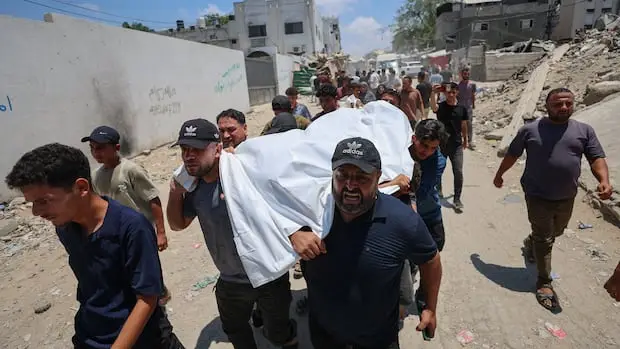
The CBC Front Burner program examines what Hamas’s potential handover of authority in Gaza could mean for future diplomacy. The discussion arrives amid a backdrop of intense humanitarian strain, periodic clashes, and a 2026 casualty toll that has left families in tents and shelters across Gaza City and beyond. A recent image captured at a camp sheltering displaced people shows mourners at the funeral of a Palestinian victim of an Israeli strike, underscoring the human cost that accompanies any political maneuvering in the region.
Analysts interviewed for the piece describe Gaza’s peace plan as a framework repeatedly stalled by mutual distrust, security concerns, and political fragmentation. They note that any dissolution of Hamas’s grip on governing Gaza would not automatically translate into a stable transition plan. Instead, a restart would depend on multiple factors: credible security arrangements, credible governance structures, and commitments from regional actors and international mediators.
Key questions highlighted include how a potential power shift would affect Hamas’s stance toward Israel and the current roadmap for a two-state solution, if at all. There is particular attention to the practicalities of governance after a reorganization: who would assume administrative responsibilities, how civil services would be reconstituted, and what conditions would govern international aid and reconstruction funding.
The program emphasizes the importance of specifying enforcement mechanisms and accountability measures in any new arrangement. It also points to the need for sustained humanitarian aid access and protection of civilians amid ongoing displacement and casualties.
While the possibility of a Hamas leadership transition in Gaza introduces a potential inflection point, experts stress that wide-ranging international consensus and a clearly defined roadmap would still be essential for any feasible path toward lasting peace. The discussion urges stakeholders to consider not only political shifts but also the daily realities faced by Gazans living under blockade and conflict.